Time Series Energy Demand Forecasting
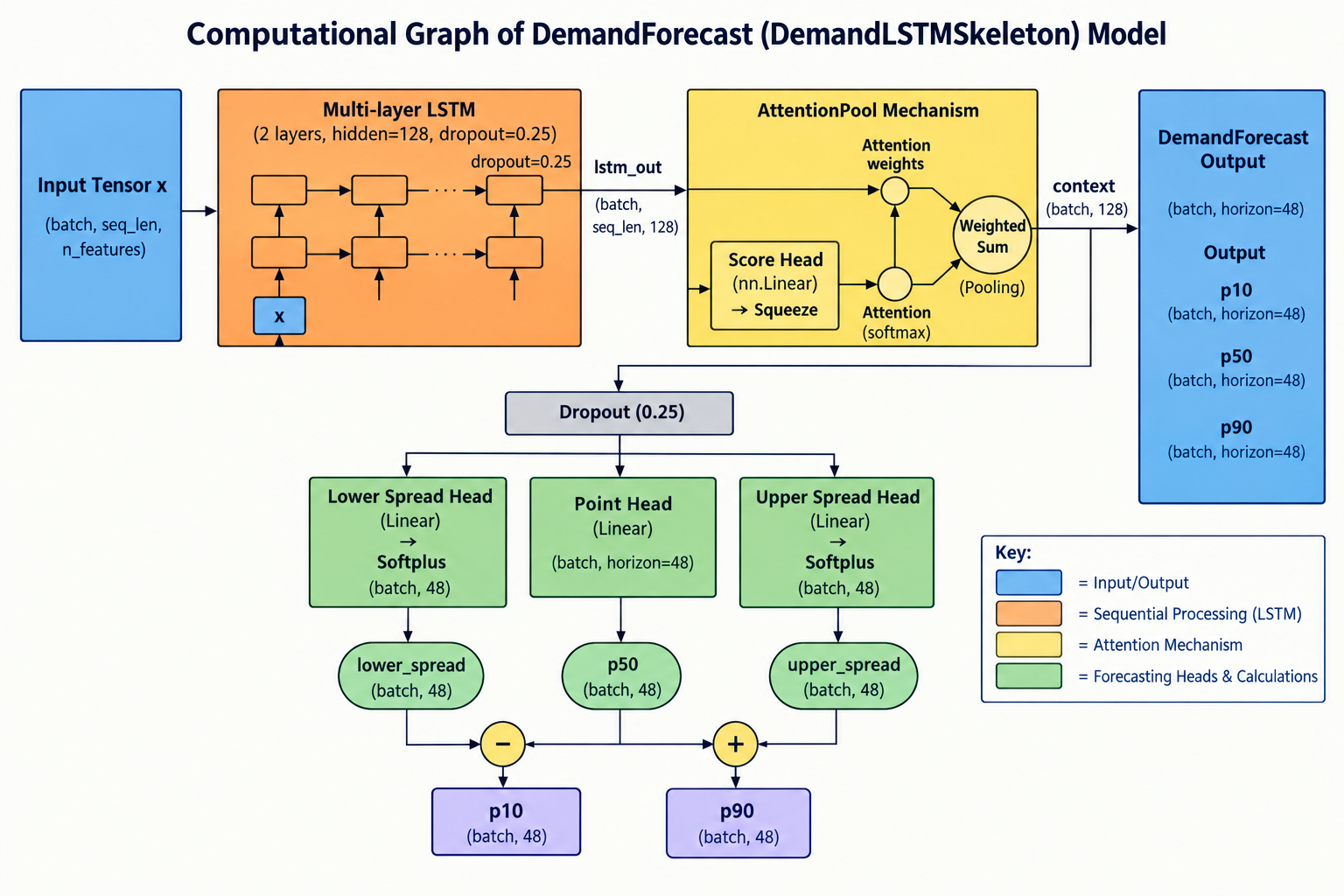
Model Architecture (DemandLSTM)
A multi-horizon deep learning model with quantile regression and attention for reliable energy demand forecasting.
Key Model Details
- Multi-horizon forecasting (48 steps)
- 2-layer LSTM (128 units each)
- Attention-based pooling
- Head dropout (rate = 0.25)
- 3 parallel heads (P10, P50, P90)
Input Shape
- (batch_size, 24, 37)
- 24 lookback steps
- 37 features
Model Outputs
- P10 (lower bound)
- P50 (median prediction)
- P90 (upper bound)
- Each: (batch_size, 48)
Why It Works
- LSTM captures temporal patterns
- Attention focuses on important timesteps
- Quantile regression provides uncertainty
- Softplus ensures non-negative spread
Use Case
- Reliable and accurate energy demand forecasts for better planning and operations.
Note:P10 ≤ P50 ≤ P90 (guaranteed by construction, because spread heads use softplus)|24 = lookback (input sequence length)|48 = forecast horizon (output length)
The full byte-level architecture detail (LSTM gate equations, DemandTFT, conformal calibration) lives in docs/architecture/model-architecture.md at the repo root.
EcoLens · Energy Grid Intelligence & Carbon Accounting